


To foster the sanctification of the people of
God, the Church commends to the special and filial veneration of Christ's faithful the Blessed Mary ever-Virgin, the Mother of God, whom Christ constituted the Mother of all. The Church also promotes the true and authentic cult ofthe other Saints, by whose example the faithful are edified and by whose intercession they are supported.
All Saints Day - Background:
All Saints' Day, All Hallows, Hallowmas ("hallows" meaning "saints," and "mas" meaning "Mass"), is a feast celebrated on November 1 or on the first Sunday after Pentecost in honour of all the saints, known and unknown. Halloween is the day preceding it, and is so named because it is "The Eve of All Hallows". All Saints is also a Christian formula invoking all the faithful saints and martyrs, known or unknown. In terms of Catholic theology, the feast remembers all those who have attained the beatific vision in heaven, while the next day, All Souls' Day, commemorates the departed faithful who have not yet been purified and reached heaven.
All Saints Day - Customs:
In Portugal, Spain and Mexico, ofrendas (offerings) are made on this day. In Spain, the play Don Juan Tenorio is traditionally performed. In Belgium, France, Hungary, Italy, Malta, Portugal and Spain people bring flowers to the graves of dead relatives.
In Poland, Czech, Sweden, Finland, Slovenia, Slovakia, Lithuania, Croatia, Austria, Romania, Hungary and Germany, the tradition is to light candles and visit the graves of deceased relatives.
In the Philippines, the day is spent visiting the graves of deceased relatives, where they offer prayers, lay flowers, and light candles.
In English speaking countries, the festival is traditionally celebrated with the hymn "For All the Saints" by William Walsham How. The most familiar tune for this hymn is Sine Nomine by Ralph Vaughan Williams.
 |
|
 |
|
 |
|---|---|---|---|---|
|
|
|
||
 |
 |
 |
||
|
|
|
||
 |
 |
 |
||
|
|
|
||
 |
 |
 |
||
|
|
|
||
 |
 |
 |
||
|
|
|

Prior to 1834, the Bank of England observed about thirty-three saints' days and religious festivals as holidays, but in 1834, this was reduced to just four: 1 May, 1 November, Good Friday, and Christmas Day. In 1871, the first legislation relating to bank holidays was passed when Sir John Lubbock introduced the Bank Holidays Act 1871 which specified the days in the table set out below. Sir John was an enthusiastic supporter of cricket and was firmly of the belief that bank employees should have the opportunity to participate in and attend matches when they were scheduled. Included in the dates of bank holidays are therefore dates when cricket games were traditionally played between the villages in the region where Sir John was raised. Scotland was treated separately because of its separate traditions; for example, New Year or Hogmanay is a more important holiday there.
The act does not specify Good Friday and Christmas Day as bank holidays in England, Wales and Ireland because they were already recognized there as common law holidays, and, because of common observance, they became customary holidays since before records began.In 1903, the Bank Holiday (Ireland) Act added 17 March, Saint Patrick's Day, as a bank holiday for Ireland only.
Current bank and public holidays
Exactly a century after the 1871 Act, the Banking and Financial Dealings Act 1971, which currently regulates bank holidays in the UK, was passed. The table below details the bank holidays specified in the 1971 Act; also listed are New Year's Day and May Day, introduced since 1971. These are deemed bank holidays by the legal device of a royal proclamation every year. In January 2007, the St Andrew's Day Bank Holiday (Scotland) Act was given royal assent, making 30 November (or the nearest Monday if a weekend) a bank holiday in Scotland.
Royal proclamation is also used to shift bank holidays that would otherwise fall on a weekend. In this way, public holidays are not 'lost' in years when they coincide with weekends. These deferred bank holiday days are termed a 'bank holiday in lieu' of the typical anniversary date. In the legislation they are known as 'substitute days'. The movement of the St Andrew's Day Scottish holiday to the nearest Monday when 30 November is a weekend day is statutory and does not require a proclamation.
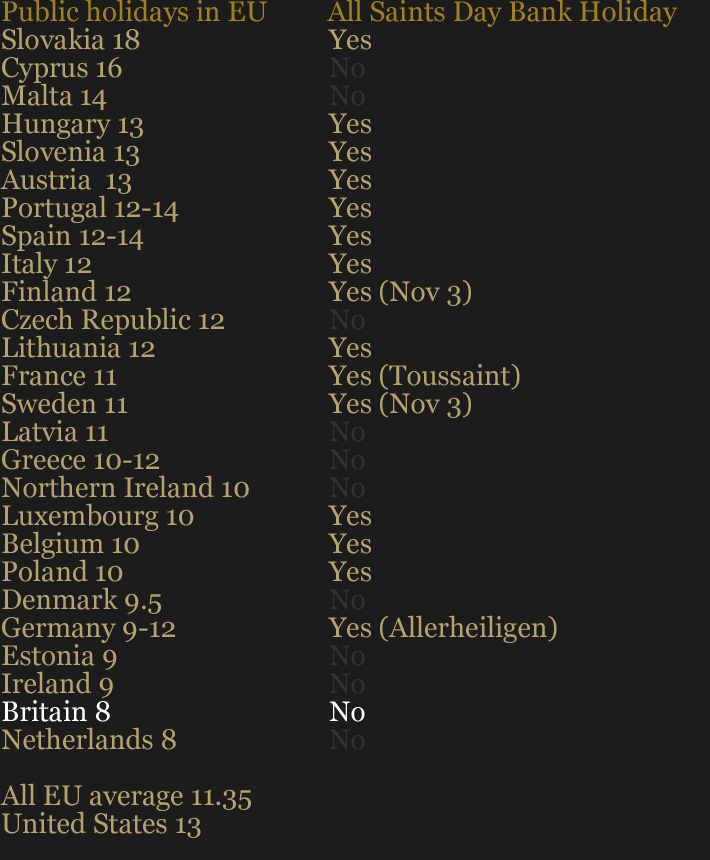

There have been calls for an increase in the number of bank holidays, particularly for recognising April 23 (St George's Day) in England and March 1 (St David's Day) in Wales to have a public holiday on the feast day of the relevant patron saint. March 17 (St Patrick's Day) is already a bank holiday in the Republic of Ireland and Northern Ireland and, from 2007, November 30 (St Andrew's Day) is a bank holiday in Scotland. There are also calls for new national bank holidays such as one to represent the United Kingdom, British Day (possibly part of Gordon Brown's new Britishness policy), Trafalgar Day as a result of the recent bicentennial, Community Day to celebrate volunteering and communities, Waterloo Day and also one to represent the European Union, making Europe Day a bank holiday, and one to represent the monarchy such as the Queen's Birthday (as in Australia, New Zealand and Canada) or coronation.
Tell the Goverment!
Make your voice heard by visiting the 10 Downing Street website and signing up to a petition. Even better, you can can create new petitions!
Content Related Links
http://www.netogram.com/holi.htm http://www.stgeorgesholiday.com/